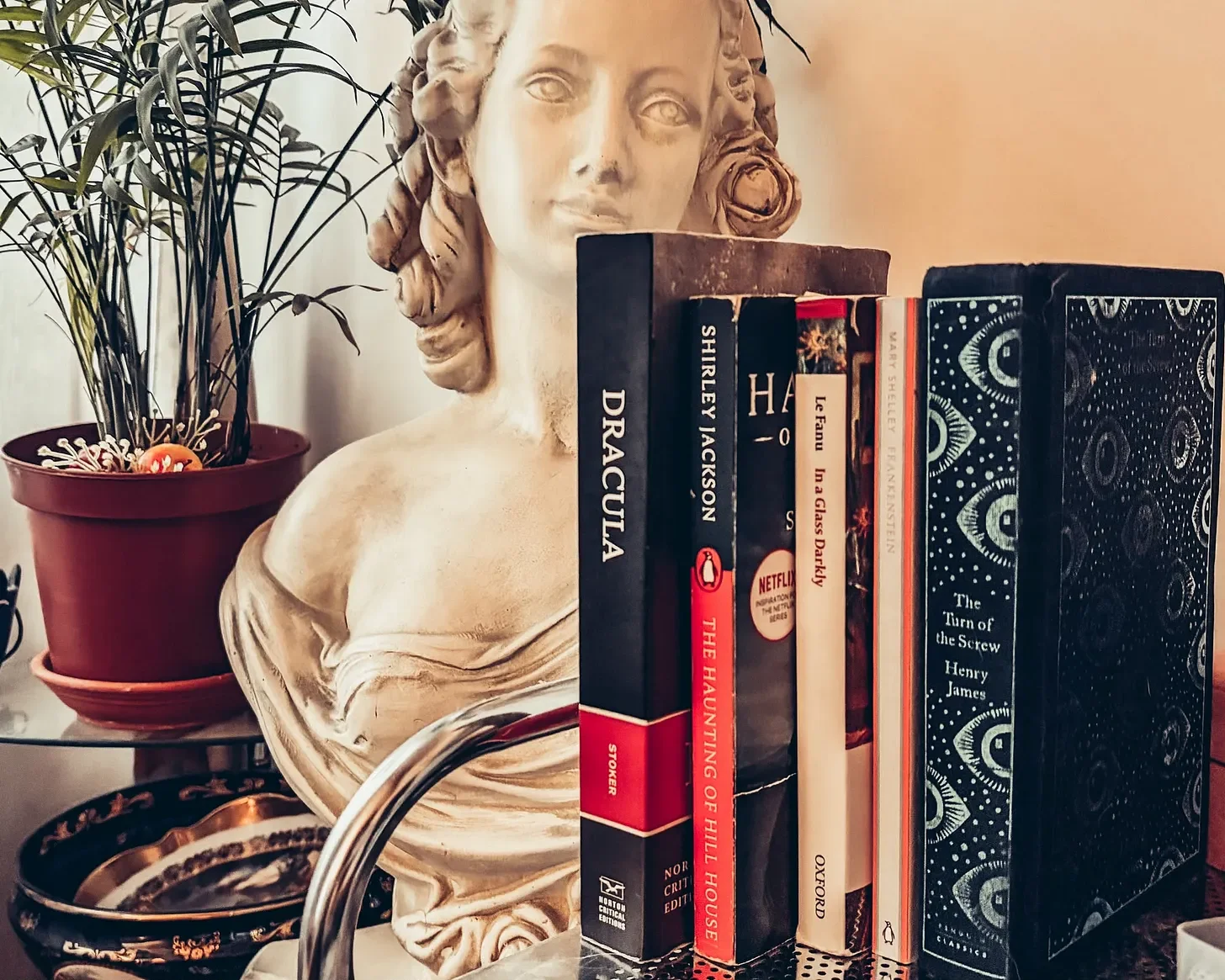
Gothic literature became my specialization ten years ago, which led me to write a bachelor’s thesis on Dracula and a master’s thesis on Carmilla and The Haunting of Hill House. The sense of transgression, the haunting descriptions, the uncanny, the moral unease, the romantic melancholy that permeates the novels are topics that I find fascinating and, in my opinion, that no other genre can represent with such finese. In honor of the spookiest month of the year, here are some of my top gothic novels to inspire a haunting October.
Dracula by Bram Stoker
The novel that started my passion for the Gothic and the topic of my bachelor’s thesis. Dracula is much more than the famous vampire. He is the personification of Western fears and a threat, on an existential level, of everything that the New World thought itself to be. Usually read as a sexual threat, Dracula actually threatens all pillars of the west: those of science, religion, power, modernity, masculinity. Dracula represents transgression, one that exists in the depths of our being, and his power to corrupt is more so, his power to bring forth the bestiality within us, the otherness that we reject. The novel begins with Jonathan Harker’s journey to Transylvania to help sell a house in England to Count Dracula. He must go to the West and meet the count in his Castle. It is in this journey that the main themes in the story are announced: vampirism, otherness, sexual repression. Everything Dracula seems to embody, which is corruptive for English society, is, ironically, represented in the five Englishmen that decide to destroy him. Dracula is fascinating because while clearly a cruel, demonic beast, his aristocratic background, his mystery, his love for learning make him a fascinating antihero and a much more likeable one than his English counterparts. (speaking heavily about myself, many readers end up rooting for and admiring him).
The Haunting of Hill House by Shirley Jackson
The inspiration for my MA thesis and a companion through many winter nights and early mornings. The Haunting of Hill House is Jackson’s masterpiece in my opinion. The way I can describe this novel (and also Flanagan’s adaptation) is that they are hauntingly beautiful. There is something delicate, feminine, melancholic, vulnerable and ephimeral about The Haunting of Hill House. It’s a work of art in itself, a museum worth preserving. Hill House tells the story of Eleanor Vance, who is one of the people that Dr. Montague invites to stay at the house for the summer and to narrate their experiences of the supernatural to him. Hill House, a house born evil, a house that through its spectrality and omnipotence becomes a character on its own. Hill House, wicked and cunning, morphs into the character’s deepest fears, giving voice to their vulnerabilities, comfort to their suffering, and horror to their realities. The house seems to have a particular liking to Eleanor, who feels accepted and loved by something for the first time in her life. The house weaves its embrace around Eleanor and segregates her from the group, hoping she becomes one of its own hauntings.
“Carmilla” by Joseph Sheridan Le Fanu
This is a short story that appears in the collection In A Glass Darkly. “Carmilla” tells the fascinating life (or death) of a female vampire. This text was published before Dracula and it had a deep influence in Stoker’s novel. In “Carmilla” we see the relationship that is formed between the protagonist and the vampire, and how Laura struggles to keep a friendship that is tainted with erotic elements between the two women, and of course, with the vampiric threat.
One of the most uncanny things is that the vampire is welcomed to the home early on in the story, thus having full control over its victim. I love the intimate setting of the story because it oscilates between being cozy and claustrophobic. It focuses on the house, especially the bedroom, which also emphasizes the sexual aspect. The novel deals with themes of death, the haunting past, sexuality, in a brilliant and very melancholic manner.
Uncle Silas by Joseph Sheridan Le Fanu
This is also a Victorian novel and it was written before Dracula. It follows the story of Maud Ruthyn and how, after she loses her family, she is forced to leave her home to go live with her uncle Silas. In this place of otherness she is threatened not only by the figure of her uncle, who is very dominant and surrounded by secrets, but also by a governess that is one of the scariest governesses I have seen. She has a tangible element of evilness that is present even in her physical appearance. You know from the very beginning that she is bad news. The figure of this governess oscilates between that of the witch and death itself. Trust me, she is very scary. Maud is also threatened by her cousin, who wants to marry her. He is very violent and… weird.
This is a very long and slow novel, so I recommend you read it on a rainy day or when you have time to enjoy it, because it really takes its time to develop. With this novel, the point is not really what happens in terms of action but what happens in the mind of the character, and how she feels trapped in this house.
The Turn of the Screw by Henry James
The novel begins with a gathering of people that are telling ghost stories on Christmas Eve and one of the men comes up with a manuscript written by a governess about 40 or 50 years before. In her manuscript, she narrates the supernatural events that occurred at Bly and how she struggled to fight the ghosts as she was protecting the two children on her charge. According to her, hauntings of the past come back to threaten the children and corrupt their innocence, but readers come to realize that her mind also begins to be haunted. The governess is a nameless protagonist and narrator, an unreliable one since many times she changes facts or doesn’t see things properly. We often see that she exerts violence on the language so that she can prove that she was right. The story becomes claustrophobic as she traps readers into her perspective. The novel brilliantly carries ambiguity because we are left wondering whether there were really ghosts haunting the manor or whether madness took over her. What’s fascinating is that there are clues to support each theory but they are not mutually exclusive. The children are also quite uncanny, overtly described as innocent angels but that somehow have knowledge of sexuality, death, and corruption that go far beyond their years. There are times in which the governess seems to become a doppelgänger for the ghosts that haunt Bly. The novel uses fragmentation in the language, the characters, the story, to emphasize the ambiguity of interpretation. This novel is an incredibly cozy haunting read for those getting started with the Gothic and the supernatural.
The Picture of Dorian Gray by Oscar Wilde
This is the story of a young man, who wishes that the picture that is made of him was the one that ages instead of himself. In a very fatidic fashion, he achieves immortality, but the painting reflects not only the corruption of his own body as he grows old but also the corruption of his soul. The painting acts as a mirror, as an uncanny mirror, of what he really looks like.
The novel explores the idea of beauty, of immortality, and also the notion of art and how beautiful objects can influence us, how we perceive and judge things on whether they are beautiful or not.
There comes a point where Dorian explores so many things about humanity, especially the wrong corrupted ones, which makes his experience tainted by death and a lack of morality that just keeps getting worse.
It’s a beautifully written novel that is a manifesto of art in itself.
Wuthering Heights by Emily Brontë
The story follows the life of two families but mainly of two characters: Heathcliff and Catherine. It is a novel about cruelty and a weird love relationship, obsession, and control. The characters are so cruel towards each other, their children, and their families that none of them can escape from the cycle of violence.
Heathcliff is obsessed with Catherine and she is obsessed with him but when she goes away, he changes forever. She is kind of the light in his life and once she moves, he becomes the cruellest man. Catherine is very manipulative. This is a peculiar couple, as the way they show their love is disturbing.
It’s fascinating to see how the novel develops a setting of two houses joined by a park, which becomes a threshold between both families. The characters change in the wilderness and show a different side of themselves than what they do at their domestic spheres. There is an exploration of identity, inner wilderness, love, thresholds, bestiality, and boundaries.
I must admit I have a weird relationship with the character of Heathcliff because I am conscious that he is cruel, violent and terrible but I can’t stop liking him and having a crush on him (I know how problematic this is). I feel that, for example, Negan in The Walking Dead is a similar character: cunning, intelligent, and handsome. Even though what he does is terrible, you cannot help admiring him. The novel purposely makes you feel that unease, since it’s quite common to root for him and it makes you wonder the stylistic devices that make you arrive to that perception of his character. Brilliantly and subtly done.
Apart from the gothic aspects that are present, like the ghosts, the secrets, and the hauntings of the past, there is also a questioning of morality and your morality as a readers, and how many wrong things you are willing to accept just because you like a character.
Ninfetta Life is a reader-supported publication. To receive new posts and support my work, consider becoming a free or paid subscriber.
Frankenstein by Mary Shelley
The novel tells the story of Dr. Frankenstein and how he goes on a quest to defeat death and revert it. After he loses an important member of his family, he becomes obsessed with the idea of being more powerful than God. He doesn’t want to create life but to revert the process of death and dying. In this exploration, he ends up making a monster from parts of human beings.
Once the monster wakes up, he panics because he cannot come to terms with the horrible creation he has made. In the novel, the monster is searching for his creator, and the creator is running away from him. It’s an interesting parallelism between God and human beings; it also tells something about motherhood, the process of becoming a mother or mother-like figure, the abandonment of a “child”, and the psychological implications of such abandonment.
One of the main things that I like about the novel is the setting because it creates very sublime landscapes, that cover the Alps, a thundra, a cottage in France, and a stormy cabin in Scotland. The landscape affects the characters’ psyche and foreshadows the threat that is following Dr. Frankenstein.
A Universal Treaty of Monsters by Lucia Laragione
This is one of the first monster books that I read as a child (the book that started my love for monsters). It’s a collection of short stories that are based on legends from the world. The author rewrites the legends with a modern twist. There are stories about Empusa, Melusine, werewolves, zombies, etc. The tales are short and easy to read but extremely engaging. It’s one of the best ways to introduce young readers or unfamiliarized readers to the gothic. I’ve been looking for a reprint or a translation in English to no avail but if Lucia Laragione and the publisher allow, I would love to write an English translation to promote her work worldwide.
The Woman in Black by Susan Hill
This is such a scary novel. It tells the story of a man who goes into a very close-minded and superstitious town but that is because many children have died in the past years and their deaths are always related to horrible accidents. The deaths are connected to the apparition of the woman in black; she might be causing the deaths. She is a woman from the victorian era, who suffered much during her life, and now she is taking revenge on the descendants of the people that hurt her (and everyone else, really. She is that evil).
There is a movie adaptation with Daniel Radcliffe and I think it’s even better than the book. Both are scary but brilliant.
Coraline by Neil Gaiman
Coraline is a little girl who moves with her family to the Pink Apartments, where she meets peculiar people. She finds a magical door that, once she crosses it, takes her into an uncanny copy of her own house. The other world seems to be perfect at the beginning since the people are friendlier (a bit too much), her mother is more welcoming and caring, etc. It seems to be a utopia of the life she wishes she had in the real world (with the exception that everyone has buttons for eyes). The problem is that the “other mother” is not what she seems to be. She lures vulnerable children into her trap. It’s a novel that appears to be directed to children but once you read it as a mature reader, you get to see how creepy and terrifying it is.
Flowers in the Attic by V.C. Andrews
This is the story of four children that are trapped in an attic after their father dies, the worst part being that their own mother locks them there. The children are very young when this happens; the twins are small children, and the older ones are pre-teens. The fact that they don’t see other people from many years and that they cannot trust anyone else, creates a very strong bond betwen them, especially between the pre-adolescent ones. This leads into a problematic relationship between them, since there are clear hints that they love each other as a couple and not as siblings but at the same time, it’s understandable because they have been isolated from the world and can only rely on each other to survive. I was a bit young to read this book at age 14 but adult readers would definitely enjoy it. This is a contemporary classic that is the first part of a six-book series. I can assure you that you’ll be hooked to continue. The second book is not as gothic as the first but it’s still a nice story to flip through.
Have you read any of these novels? Comment your favorite ones and give your recommendations below!